

 Email us



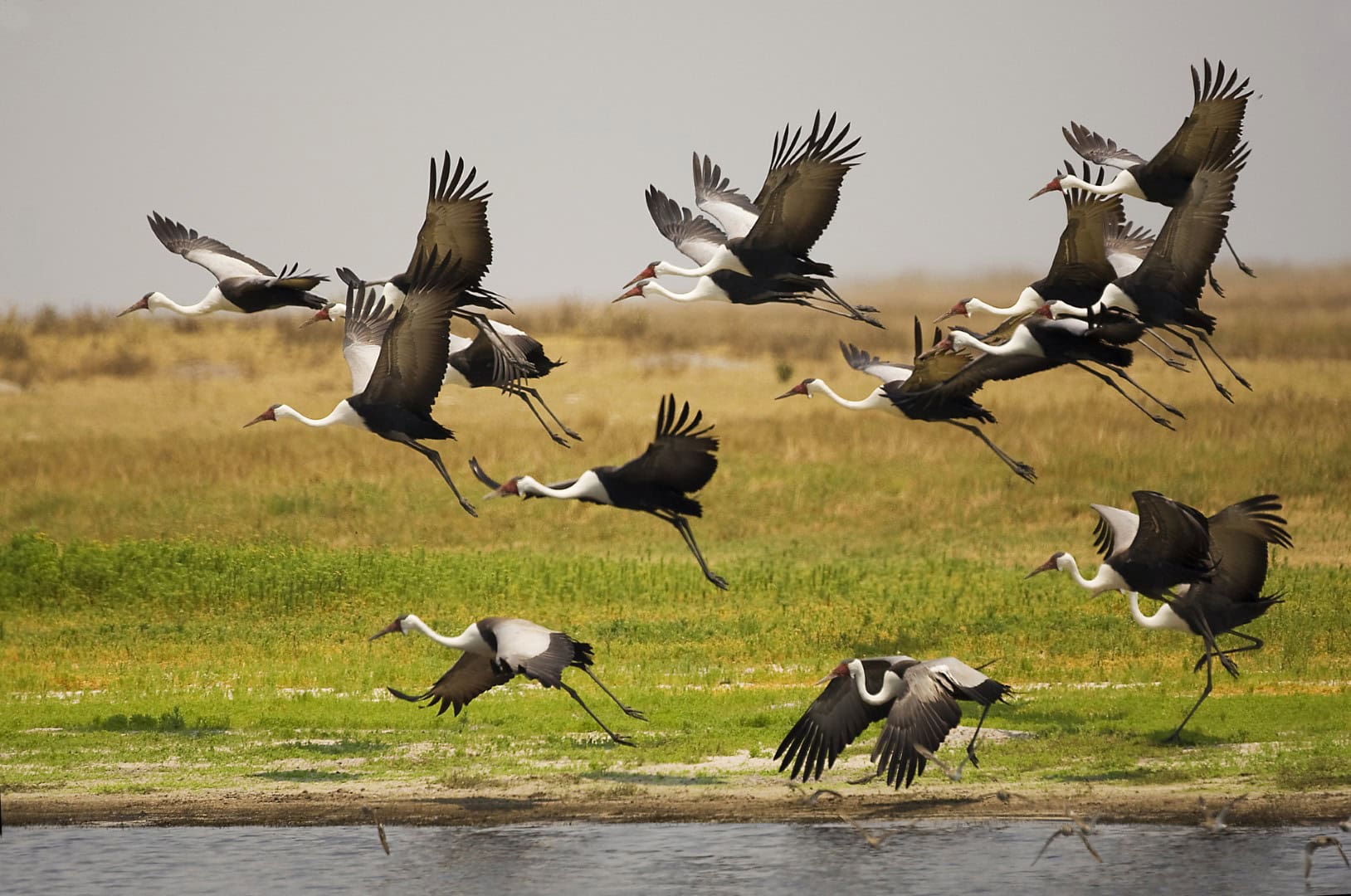
To travel through Africa with an eye tuned to its birdlife is to experience the continent at a totally different tempo. While standard game drives often sweep past acacia groves in search of apex predators and other big game, a dedicated birding safari invites stillness.
It asks you to listen: to decipher the alarm call of a spurfowl, notice the sudden flush of wings against riverine reeds, and appreciate the delicate balance of an ecosystem where every feather tells a story of adaptation, migration, and survival.
Across the continent, an estimated 2,500 bird species inhabit a staggering range of biomes – from the freshwater papyrus swamps of Uganda to the soda lakes of the Great Rift Valley and the mist-laden Afro-montane canopies. Many of these are rare birds found nowhere else on Earth.
Encountering them in their natural habitats is also an act of witness. African bird species serve as primary bio-indicators; their presence, or disappearance, reveals the health of Africa’s most sensitive wilderness areas.
Planning an itinerary that could bring you face-to-face with Africa’s most elusive avian treasures requires local precision, seasonal understanding, and deep patience. Here’s our specialist guide to six of the continent’s most extraordinary rare birds, where to look for them, and how your presence directly aids their protection.
Rare African Birds and Where to Encounter Them
1. The Shoebill (Balaeniceps rex)
Status: Vulnerable (IUCN Red List)
Key Biomes: Freshwater papyrus swamps, floodplains, dense marshlands
Prime Destinations: Mabamba Swamp and Murchison Falls (Uganda), Bangweulu Wetlands (Zambia)
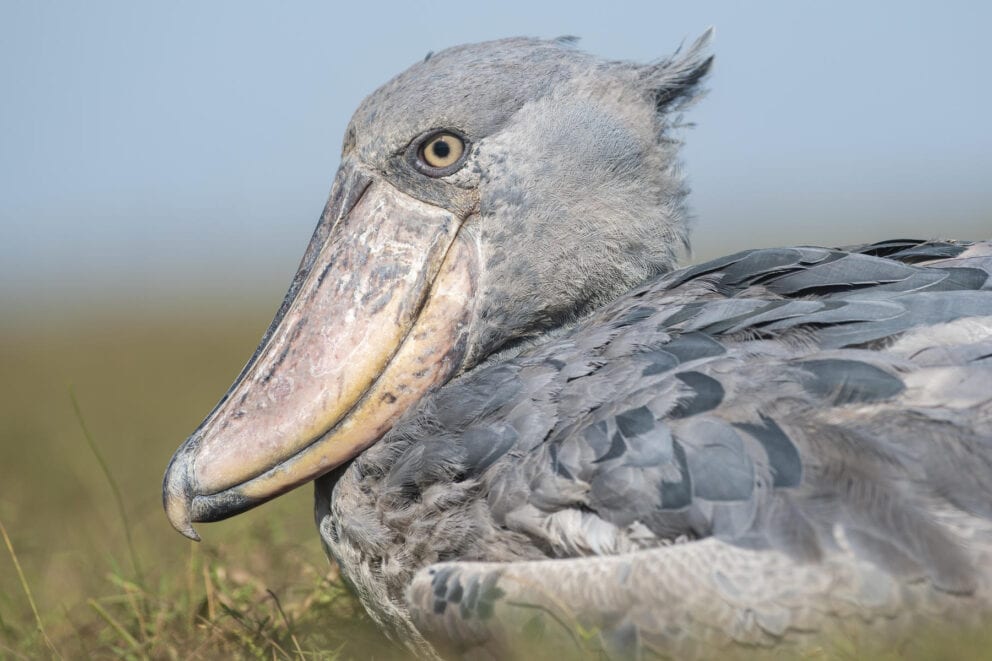
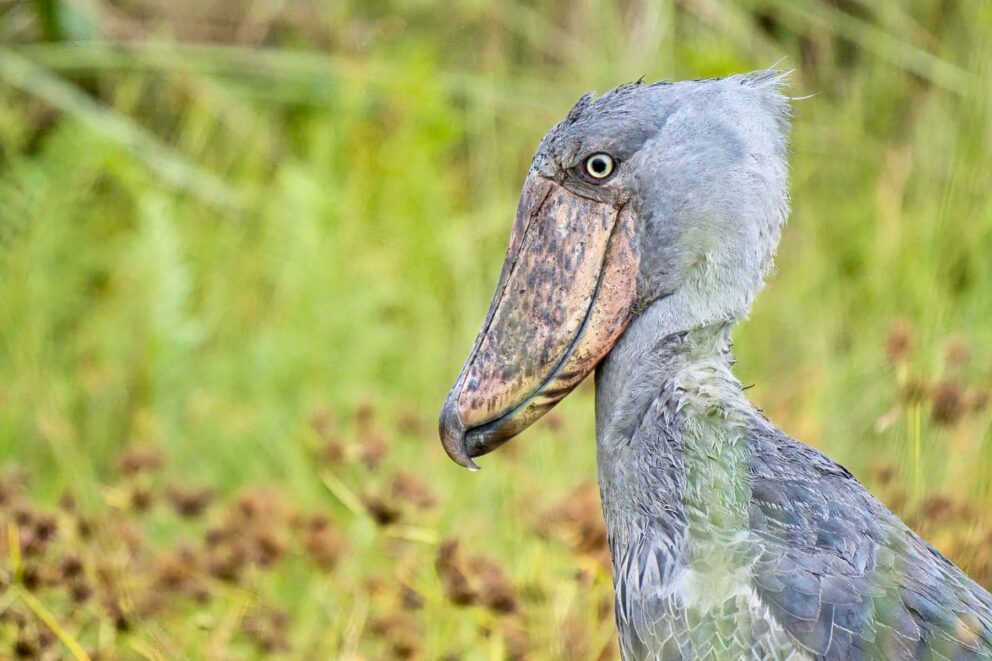
Standing up to 1.5 m tall with a prehistoric silhouette, slate-grey plumage, and a bulbous, razor-edged bill shaped like a Dutch wooden clog, the Shoebill looks like a relic from the Cretaceous era. Despite its name, this solitary predator is phylogenetically closer to pelicans and herons than to true storks.
It’s an ambush hunter of legendary patience, capable of standing motionless in water for hours before launching a violent, headfirst “collapse” strike to capture lungfish, tilapia, and water snakes.
Encountering a Shoebill is an adventure that requires stepping off standard safari circuits. In Uganda’s Mabamba Bay Wetland, a recognised Ramsar site, you navigate a labyrinth of narrow water channels aboard an engine-free, pole-punted wooden canoe with community-trained boatmen. In Zambia’s remote Bangweulu Wetlands, the pursuit is raw and physical: wading through knee-deep water alongside local scouts who monitor nesting pairs.
Conservation Context: According to species monitoring assessments on the BirdLife International DataZone, wild shoebill populations are threatened by wetland drainage for agriculture, burning of breeding habitat, and the illegal live-bird trade. Sustainable community tourism in places like Bangweulu provides local fishermen with direct alternative employment as dedicated wetland guardians, demonstrating how targeted eco-travel directly preserves fragile breeding grounds.
2. The Taita Apalis (Apalis fuscigularis)
Status: Critically Endangered (IUCN Red List)
Key Biomes: Fragmented Afro-montane cloud forest canopies
Prime Destinations: Taita Hills (South-Eastern Kenya)
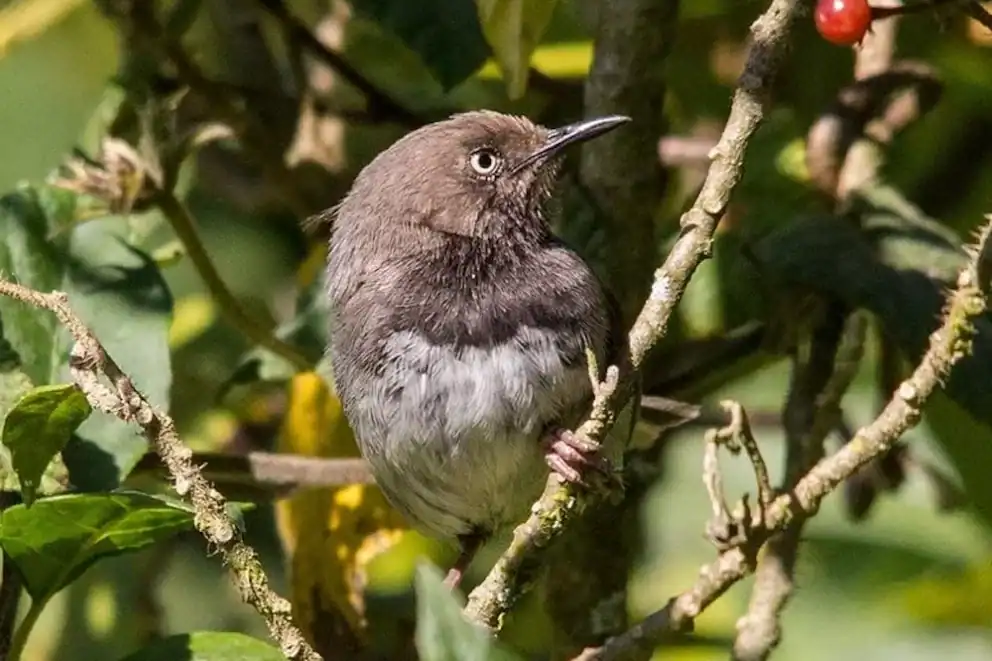
The Taita Apalis is one of the rarest bird species in the world. A tiny, slender warbler with dark charcoal upperparts, a black throat, and pale underparts, this canopy dweller is confined strictly to tiny remnants of mist-shrouded cloud forest atop the Taita Hills in southeastern Kenya.
Because its natural range has been broken into isolated mountaintop patches by subsistence farming, finding the Apalis requires an adventurous ascent. Hikers trek through high-elevation indigenous forests, guided by local naturalists who identify the bird’s rapid, territorial clicking calls amid the moss-draped branches.
Conservation Context: The global population has suffered a catastrophic collapse with fewer than 150 to 200 mature individuals remaining. The survival of the Taita Apalis hinges entirely on habitat connectivity.
Over 95% of the indigenous Taita Hills forests have been cleared due to human population density. Conservation groups like Nature Kenya and the Rainforest Trust are actively working to save the species. Current initiatives include land purchases to create protected reserves, removing invasive plant species, and restoring exotic timber plantations back into native indigenous forests.
3. Wattled Crane (Bugeranus carunculatus)

Status: Vulnerable (IUCN Red List)
Key Biomes: Undisturbed floodplains, large dambos, seasonal marshes
Prime Destinations: Okavango Delta (Botswana), Kafue Flats (Zambia)
The largest and rarest of Africa’s cranes, the wattled crane is a wetland specialist standing nearly 1.8 m tall. Its appearance is striking: an immaculate white neck and breast contrast against slate-grey wings and a distinctive red face decorated with two white, fleshy wattles hanging from the chin.
The wattled crane’s lifecycle is intimately bound to the natural flood pulses of intact river systems. They thrive in large, open marshes, dambos, and floodplains and rely on the seasonal expansion and retraction of shallow water to feed on submerged tubers, rhizomes, and sedge seeds.
They are monogamous and mate for life after performing elaborate courtship dances that involve jumping, bowing, and wing flapping. Both males and female cranes perform this lavish display leading up to and during the breeding season, which generally runs from April to November.
The wild waterways of Botswana’s Okavango Delta and the sprawling Kafue Flats in Zambia are the wattled crane’s greatest remaining strongholds and thus the best place to spot them. The Delta holds the single largest population of the species, with a premier hotspot being the Moremi Game Reserve.
Spotting a breeding pair foraging against an open horizon is among the most peaceful, visually arresting wildlife spectacles in southern Africa.
Conservation Context: Upstream dams, hydrological shifts, and wetland conversion have significantly impacted nesting success across their range. Responsible safari camps located within private concessions in the Okavango Delta maintain strict, low-impact boat traffic quotas, preserving hydrological integrity and guarding these shy birds from human disturbance during crucial brooding periods.
4. White-Winged Flufftail (Sarothrura ayresi)
Status: Critically Endangered (IUCN Red List)
Key Biomes: High-altitude sub-alpine peatlands and freshwater marshes
Prime Destinations: High-altitude wetlands of Mpumalanga, Free State, and KwaZulu-Natal (South Africa)
For dedicated birders, the white-winged flufftail is almost mythological. This small, highly secretive rail-like bird measures just 14 cm in length, featuring rich chestnut markings and brilliant white secondary flight feathers that only flash when the bird takes sudden, reluctant flight from dense sedge.
Widely considered Africa’s rarest bird, its global population is estimated at fewer than 250 mature individuals, only found in South Africa and Ethiopia. They’re severely threatened by habitat loss, agriculture, and human population growth and are famously cryptic and elusive. Finding one, therefore, demands extraordinary discipline.
Instead of flying, the white-winged flufftail prefers to scurry quickly through dense marsh vegetation, and its presence is usually detected only by its soft, hooting calls. The best time and place to see these rare birds is during the summer months (November to March) in the high-altitude wetlands along the Eastern Escarpment (including sites in Mpumalanga, KwaZulu-Natal, and the Free State) of South Africa.
Note: As habitats are strictly protected, viewings are rare, tightly regulated, and non-invasive.
Conservation Context: The white-winged flufftail survives only in pristine, high-elevation peatlands – ecosystems that act as vital regional water sponges. Scientific updates from the IUCN Red List emphasise that draining these high-altitude sponges threatens human clean-water security as much as the bird itself.
Dedicated conservation programmes are using camera traps and acoustic monitoring to map their remaining nesting areas, supported by eco-lodges partnering with local landowners.
5. Shelley’s Crimsonwing (Cryptospiza shelleyi)
Status: Endangered (IUCN Red List)
Key Biomes: Afro-montane Albertine Rift bamboo belts, dense forest edges, and mist canopies
Prime Destinations: Bwindi Impenetrable National Park and Mgahinga Gorilla National Park (Uganda), Volcanoes National Park (Rwanda)
If you’re a birder planning on exploring the Albertine Rift, the Shelley’s crimsonwing is considered one of the holy grails of African birding. Measuring just 13 cm, this striking little finch exhibits rich, bright red plumage draped across its mantle and back. This contrasts beautifully with a vivid crimson-coral bill, an olive-yellow belly, and dark wings.
Despite its radiant colours, the crimsonwing is astonishingly cryptic and an increasingly rare sight. It inhabits dense, closed-canopy moist forest, often in the valley bottoms near water, as well as low forest clearing and glades. They’re found throughout the Albertine Rift forests, including the forests of Rwanda and Uganda.
Conservation Context: Confined entirely to the narrow montane forest ridge of the Albertine Rift, the global population is estimated at fewer than 2,500 individuals and continues to decline. Its fragile habitat has been severely fragmented by agricultural encroachment from surrounding high-density rural populations.
High-value ecotourism generated by primate tracking and guided birding walks in parks like Bwindi provides essential funding to maintain contiguous transboundary forest corridors across Uganda and Rwanda.
6. Pel’s Fishing Owl (Scotopelia peli)

Status: Least Concern / Regionally Vulnerable in Southern Africa (IUCN Red List)
Key Biomes: Riverine gallery forests, pristine waterways, and subtropical swamps
Prime Destinations: Okavango Delta (Botswana), Pafuri / northern Kruger National Park (South Africa), Lower Zambezi (Zambia)
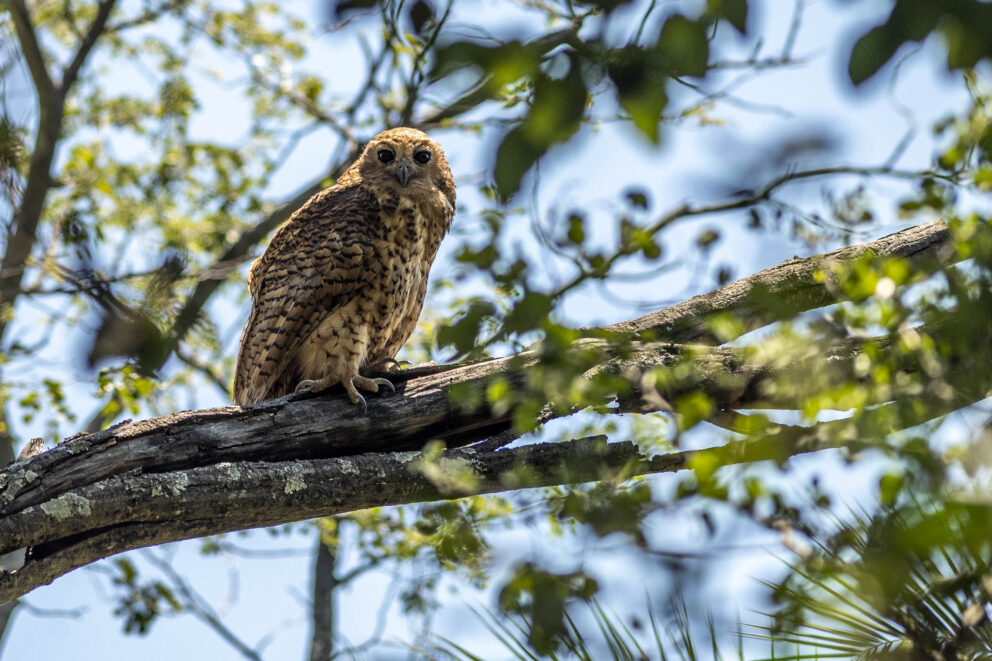
Among the most elusive and sought-after nocturnal ticks, the Pel’s fishing owl is an unmistakeable giant of Africa’s riverways. Sporting a rich ginger-rufous plumage, piercing dark eyes, and an enormous round head, this might be one of the most striking birds in Africa.
With a length of about 60 cm and a massive 180 cm wingspan, it’s one of the largest owl species in the world. Unlike owls adapted for silent rodent hunting, Pel’s fishing owl lacks fringed flight feathers because fish cannot hear airborne wingbeats. Instead, it possesses naked, heavily spined foot pads (spicules) designed to grip slippery, thrashing fish snatched right from the surface film.
Even though this bird is technically classified as Least Concern on the global IUCN Red List, it’s still considered a rare find among ornithologists and birders. This is mainly due to their extremely low density and extreme habitat specificity. They only survive along intact, slow-moving river systems and oxbow lagoons lined with mature, broad-canopied gallery forest.
Additionally, its nocturnal nature means it’s rarely seen. They roost high in the darkest foliage of riverine trees during the day. So, unless you track them at dusk, they’re virtually invisible to the average observer.
Conservation Context: Because Pel’s fishing owls require mature, large-canopy riverine timber for nesting and crystal-clear, unpolluted waterways to visually locate prey, they serve as crucial indicators of river health. Upstream water diversion, siltation from deforestation, and the clearing of large gallery trees have caused local populations to drop sharply along southern African margins.
Responsible safari concessions in places like the Okavango Delta protect these pristine river corridors from logging and commercial overfishing.
When to Go on an African Birding Safari
Designing a birding safari requires matching your travel dates to the seasonal patterns of the continent’s distinct biomes. Birding in Africa is never static; the movement of water and rain orchestrates where species gather and breed.
The Green Season (November to April): Widely regarded by field ornithologists as the most rewarding window for general birding. Millions of Palearctic and intra-African migrants arrive, swelling resident populations. Resident birds moult into striking breeding plumage, vocal activity is at its highest, and lush greenery offers extraordinary photographic contrast.
The Dry Season (May to August): As foliage thins and seasonal pans dry up, waterbirds congregate around permanent river systems, floodplains, and deep lagoons. Visibility through riverine gallery forest is significantly clearer, making it an ideal period for tracking shy species like Pel’s fishing owl or walking for Afro-montane endemics.
The Spring Shoulder (September to October): A dynamic transition. Temperatures climb, and the first wave of intra-African migrants arrives to establish territories, making it a thrilling window for courtship observations and nesting behaviours.
One of the most spectacular spring displays is the arrival of southern carmine bee-eaters in the Zambezi River Basin and the Okavango Delta.
Take the Next Step
A truly rewarding birding journey cannot simply be pulled off a shelf. It requires deliberate pacing, private guiding, and careful planning around micro-seasons and remote habitats. Our safari specialists are based in Africa. We know which private concessions allow night drives to look for Pel’s fishing owls, which lodges have walking guides well-versed in birding, and how water levels shift month by month.
Whether your goal is a dedicated photographic journey to track rare endemic birds or a balanced safari that blends iconic big-game viewing with mindful bird watching, we take the time to understand your pace, passions, and travel style. Africa’s wild biomes reward those who take the time to look closer. If you’re ready to design a journey shaped around meaningful wildlife encounters, quiet wilderness, and expert-led discovery, we’re here to guide you.

Written by Thaakiera Ackerdien
• Travel Writer


Verified by Adelle Bell
• Africa Safari Expert
Discover the African Journey that’s Right for You
 Blog List





























Written by Thaakiera Ackerdien
• Travel Writer
Verified by Adelle Bell
• Africa Safari Expert
Part of the East Africa Safari, Southern Africa Safari & Birding Safaris Collections